
Water treatment without grid electricity
A crank or pedal powers the UV lamp in this water-treatment prototype, described by Wang and colleagues in ACS Nano in 2026. This project examines its possible use after displacement and the conditions a field trial would need to assess.
Project notes by Jerry Zou.
Water supply and water treatment
UNHCR’s 2024 WASH report covered 104 settlements in 17 countries, serving 3.2 million people. Reported daily water provision averaged 18 liters per person, and 69 percent of reporting sites fell below minimum standards. UNHCR’s monitoring report provides the full scope.
A family needs enough water, and that water needs to be safe. The two problems overlap, but a treatment device cannot make up for a dry well or a broken delivery system. TEHG-UV disinfects water already available to the user.
At Dabat Bosin in Sudan, UNHCR reported just four liters per person per day in 2024, against a post-emergency standard of 20 liters. That daily requirement includes cooking and hygiene as well as drinking.
For a country-level view, see WHO/UNICEF drinking-water data, presented by Our World in Data. The 2025 data release covers 2000–2024. National estimates provide context; conditions in individual settlements require local evidence.
How the device works
Xingwei Wang and colleagues combine two generators to power a UV lamp. The engineering problem is that starting the lamp and keeping it running require different electrical outputs. Their hybrid system changes its electrical behavior to accommodate both stages.
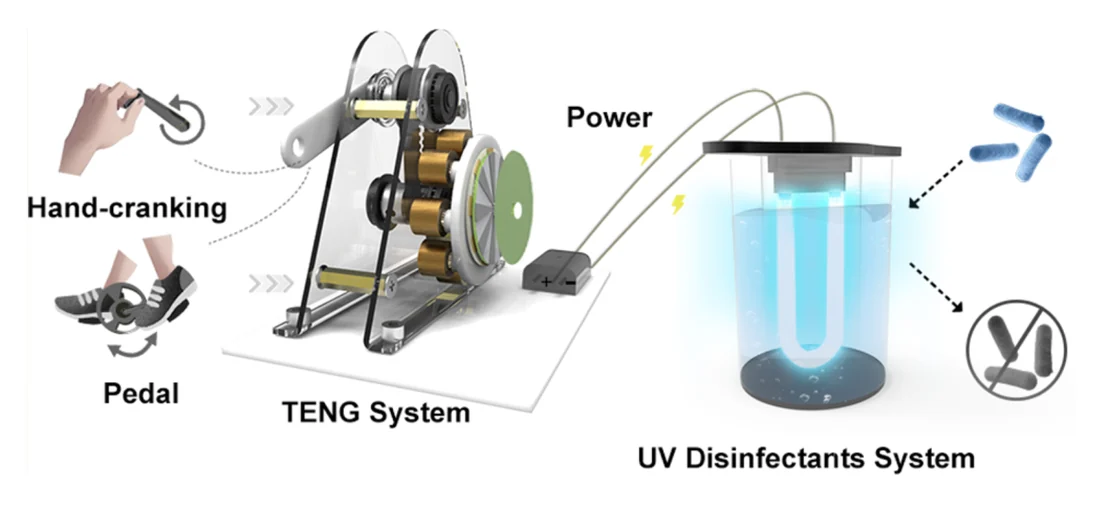
A crank or pedal drives a triboelectric nanogenerator (TENG) and an electromagnetic generator (EMG). Contact and separation between materials produces charge in the TENG; electromagnetic induction produces current in the EMG.
The TENG supplies high voltage useful for starting the lamp. The EMG supplies the current needed to sustain operation. Combining them allows the system to respond to the lamp’s changing impedance without drawing operating power from the grid.
The lamp’s radiation inactivates microorganisms.
The study reports treatment of two liters in 25 minutes with hand-cranking and ten liters in 15 minutes with pedaling. In smaller tests, 500-milliliter samples deliberately contaminated with E. coli, B. subtilis or MS2 bacteriophage reached an eight-log reduction within five minutes at 80 rpm, with five replicates. These results apply to the tested organisms and laboratory conditions. WHO evaluates bacteria, viruses and protozoa separately; these results alone do not establish a WHO product classification.
The authors estimate a levelized cost of $8.57 per person per year, using fabrication costs and assumed component lifetimes. It is not a retail price or a measured cost of deployment in a refugee settlement.
Before a field trial
The researchers designed TEHG-UV for households in regions with limited electrical infrastructure. A possible trial would start with households that have accessible water, a microbial-treatment need, and unreliable power.
Conversations with water-service staff and prospective users would need to establish whether a hand-cranked or pedal-powered device fits their daily routines and offers an advantage over the treatment they already use.
Water quality would shape any trial. UV does not remove chemical contaminants or heavy metals. Cloudy water may need pretreatment, and treatment for chemical contamination must address the substances present.
Physical effort, cleaning and protected storage also need assessment. UV leaves no continuing disinfectant residual, while the mercury lamp requires a workable plan for breakage, replacement and disposal. A trial would need to measure performance and upkeep over sustained use.
Other treatment methods
The methods below have different requirements for power, supplies and storage. Performance depends on the device, dose, water quality and use conditions.
| Method | What it needs | Practical consideration |
|---|---|---|
| TEHG-UV | Mechanical effort, lamp and working generator | Laboratory prototype; field use and upkeep need evaluation |
| Chlorination | A supply of disinfectant, suitable dose and contact time | Residual can protect stored water; effectiveness varies by organism |
| Boiling | Heat and a suitable vessel | Cooling, safe handling and clean storage |
| Solar disinfection | Clear containers, sufficiently clear water and sunlight | Cloud cover increases the required exposure time |
| Portable electric UV | Power, including batteries in some devices | Water clarity, treatment dose and charging or replacement power |
Research background and project status
Dr Xingwei Wang holds a PhD from Tsinghua University. Dr Wang works in collaboration with Prof. Zhiguo Yuan of City University of Hong Kong on water disinfection. Prof. Yuan is a Fellow of the Australian Academy of Technology and Engineering. The TEHG-UV study acknowledges support through FIRST, a City University of Hong Kong programme endorsed by UNESCO.
The research group developed TEHG-UV and carried out the laboratory experiments. This project is at the stage of assessing possible uses after displacement; a field trial remains to be designed.
Author’s note — Jerry Zou
I am working with the research group to consider the device’s possible relevance to displacement and to explain the research to humanitarian organizations. My next step is to prepare a short technical note for water-service staff and discuss a specific water problem with researchers, local staff and prospective users.


Work with water access?
Tell us how water is collected and treated where you work, and which problems take the most time to solve. These details can help assess whether the device fits a local need.