
Sand Cartels
Illegal Dredging in Southeast Asia and Coastal Displacement
How sand extraction and the trade supplying land reclamation affect riverbanks, coastlines and the people living there.
Updated October 6, 2026
“In my house, the walls were filled with sand for more than half the height. One night, I lost everything. Now I have no place to stay.” said a local housewife from Rojoniline village in northern Bangladesh. Her family was forced to leave their home after sediment-heavy flash floods—driven by unchecked sand mining in the area—overwhelmed their village. [1]
An estimated 20 to 50 million Bangladeshis are projected to be displaced from coastal areas due to river erosion by 2050. The relentless extraction of sand in Southeast Asia is leaving communities like Rojoniline facing an uncertain future, only to fulfill Singapore’s land reclamation ambitions. As a key source for its artificial land expansion, Singapore’s high demand for imported sand from countries like Cambodia and Indonesia has led to excessive sand mining, causing land loss and forced displacement. Despite efforts to outlaw sand mining and transnational trade, attempts to curb sand smuggling have largely failed due to various factors. [2] [3] [4]
The Expense Beneath a Growing Nation
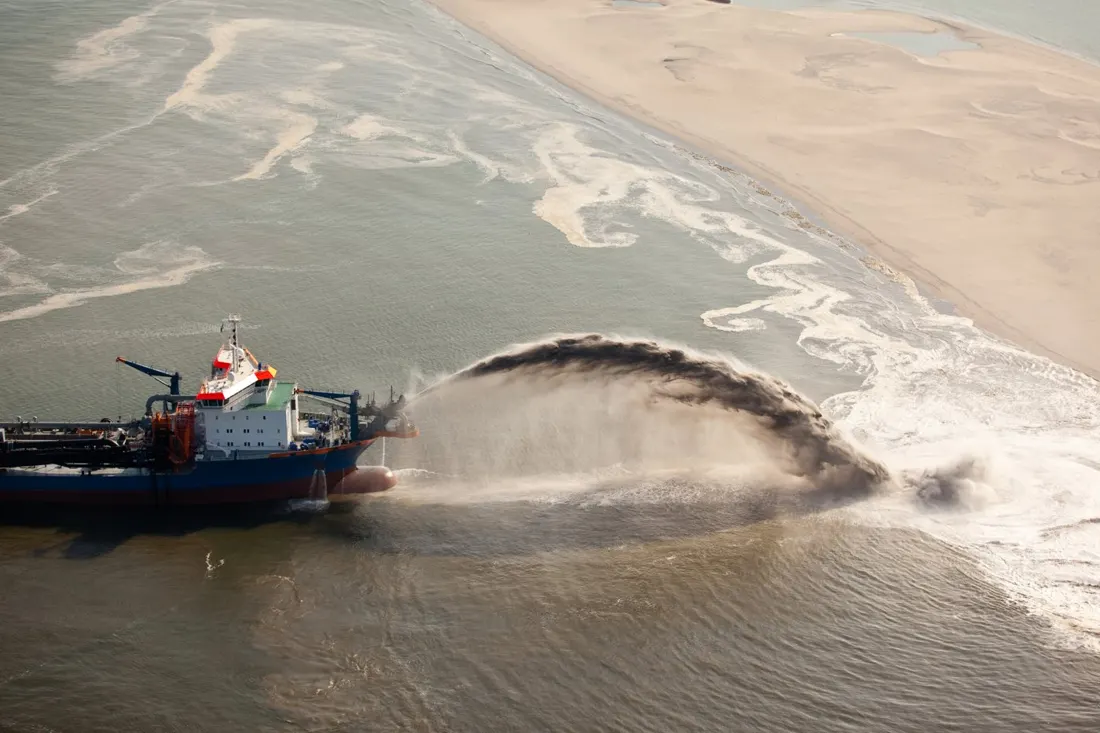
Between 1997 and 2017, Indonesia, Malaysia, Cambodia, and Vietnam—historically Singapore’s largest sand exporters—banned sand exports due to environmental concerns. However, Singapore, having spent another $57.5 million on sand imports in 2023, has continued prioritizing land reclamation as a driver of economic and infrastructural development since independence. To achieve its goal of expanding to 766 square kilometers by 2030, the country has increasingly relied on illegal channels to meet its growing sand demand. In Vietnam, investigative journalist Le Dinh Tuyen uncovered that licensed mining operations in the Mekong Delta met only 10–20% of actual market demand, suggesting that most sand extraction occurs illegally through unregulated dredging. Such illicit activities were also evident in Indonesia, where enforcement agencies intercepted multiple unauthorized dredging vessels in 2023. These operations devastate ecosystems and local communities, eroding coastlines and forcing millions to relocate. [4] [3] [5] [6]
iStock / Freezingtime
Similar to the secrecy of the mining and smuggling process, the consequences of illegal sand dredging remain largely undocumented, with limited reporting specific to the Mekong Delta. However, even the available reports indicate that sand mining has caused extensive displacement due to severe riverbank erosion and collapses. In 2023, authorities recorded 585 major erosion hotspots spanning 741 kilometers, threatening both land and homes. Between 2018 and 2022, 2,500 houses were swept away across An Giang, Dong Thap, Can Tho, Vinh Long, and Ca Mau provinces. These losses have disrupted rural livelihoods, damaged infrastructure, and forced families into precarious relocation. The destruction extends beyond housing—farms, fishponds, and roads have also been lost. This displacement is not merely environmental but a direct consequence of intensive, often illegal sand mining, which destabilizes riverbeds and accelerates erosion. [7] [8]
Loopholes, Profits, and Corruption: The Machinery Behind Sand Theft
The illicit sand trade thrives on economic incentives, technical loopholes, and institutional gaps. The primary driver is soaring demand for Singapore’s land reclamation, propelling sand consumption and market value to an expected 955 million tons and $28.6 billion by 2035. The substantial profits from sand mining often outweigh the risks of illegal operations. These incentives intersect with regulatory blind spots, leading to widespread abuse. Legal loopholes are also present in Indonesia: enforcement agencies intercepted multiple unauthorized dredging vessels following the lifting of its 20-year sea sand export ban in 2023, which smugglers interpreted as tacit permission for unregulated mining. The use of unregistered dredging barges further enables these operations to remain invisible to official tracking systems. [9] [6]
Institutional weaknesses, including fragmented jurisdiction and corruption, reinforce these illegal activities. Provincial governments often act in isolation with minimal coordination, and in some cases, local officials have colluded with smugglers, issuing unauthorized permits or ignoring violations altogether.
Without effective controls, over-extraction leads to environmental devastation. In Vietnam’s Mekong Delta, sand dredging has depleted sediment stocks, lowered riverbeds, increased bank erosion, and caused saltwater intrusion into freshwater areas, threatening agriculture and fisheries. These crises have far-reaching implications of displacing coastal communities and inhabitants that rely on fishing for survival.

iStock / kertu_ee
The Fragility of Modern Solutions
Despite diverse regulatory systems in Southeast Asia, current solutions to illegal sand mining are undermined by a variety of limitations. In 2023, the UN Environment Programme launched Marine Sand Watch that uses satellite data to track dredging vessels and detect sand extraction within marine protected areas. It identifies high-risk zones, maps dredging activity, and enhances transparency, helping policymakers monitor and respond to unsustainable marine sand mining practices on a global scale including Southeast Asia. [10]
Similar technological approaches are also present in independent nations: In both vietnam mekong delta and malaysia, authorities have implemented the AIS monitoring system, which operates by installing AIS signal devices on sand mining vessels, which transmit real-time data such as location, speed, and direction. Authorized extraction zones are digitally marked, and if a vessel moves outside these boundaries, the system instantly alerts authorities. However, both systems face critical limitations. Marine Sand Watch covers only about 60% of the global dredging fleet and lacks enforcement power, reducing its role to monitoring rather than prevention while leaving a portion of the illicit dredgings in Southeast Asia undetected. Similarly, AIS can be manipulated—vessels may disable transponders, falsify GPS data, or bypass detection entirely. Moreover, it functions reactively, recording breaches after they occur rather than preventing them in real-time. Besides, many local authorities lack the resources to respond swiftly, as illegal sand dredging remains underreported and often receives insufficient regulatory attention. [11] [10] [12] [7]
Beyond Surveillance: Structural and Systemic Strategies
Despite the shortcomings of current approaches, these weaknesses reveal opportunities for more effective solutions. A decentralized blockchain-based permit and tracking system can improve monitoring of illicit sand mining. Each shipment will be attached to a unique, immutable digital permit containing verifiable data such as extraction volume, coordinates, and time. Drones equipped with LiDAR and AI mapping can cross-check these parameters on-site. Unlike AIS and satellite systems that are vulnerable to manipulations, this system links each transaction to a traceable record, closing loopholes like forged invoices or disabled transponders. In addition, blockchain’s public transparency limits corruption by removing sole reliance on local officials for verification. [13]
Tracking shipments would still leave practical questions: who checks whether the recorded extraction matches the permit, who investigates a discrepancy, and what happens when a vessel stops transmitting? Any proposed system needs to explain how a warning leads to an inspection or enforcement action.
Sources
- Islam et al. (2022). How Do Vulnerable People in Bangladesh Experience Environmental Stress From Sedimentation in the Haor Wetlands? An Exploratory Study. Water Resources Research. DOI: 10.1029/2021WR030241.
- VICE. Illegal sand mining is creating an ecological crisis in Bangladesh.
- SG101. Sand and land reclamation in Singapore.
- Eco-Business. Indonesia’s risky gamble with sea sand exports.
- Earth Journalism Network. EJN-supported investigation leads to crackdown on illegal sand mining.
- Mongabay. Reporting on sea sand dredging, Indonesia and exports to Singapore (February 2025).
- The Management of Offshore Sand Mining: A Systematic Literature Review. ResearchGate.
- Park (2024). Sand mining in the Mekong Delta: Extent and compounded impacts. Science of the Total Environment. DOI: 10.1016/j.scitotenv.2024.171620.
- IndexBox. Asia-Pacific natural sand market overview.
- Stanford Center for Ocean Solutions. Sand dredging encroaches on marine protected areas, scientists find.
- Vietnam Agriculture. AIS monitoring system: the magic eyes for tracing mineral mining.
- Global Fishing Watch. Research project on disabled vessel signals.
- UC Berkeley Research. New research aims to curb illegal sand mining with data-driven mapping tools.